
What does Industry 4.0 really mean in practice?
Understand what Industry 4.0 means in practice and how data, sensors, systems and dashboards help improve industrial management.
 Pedro Iamondi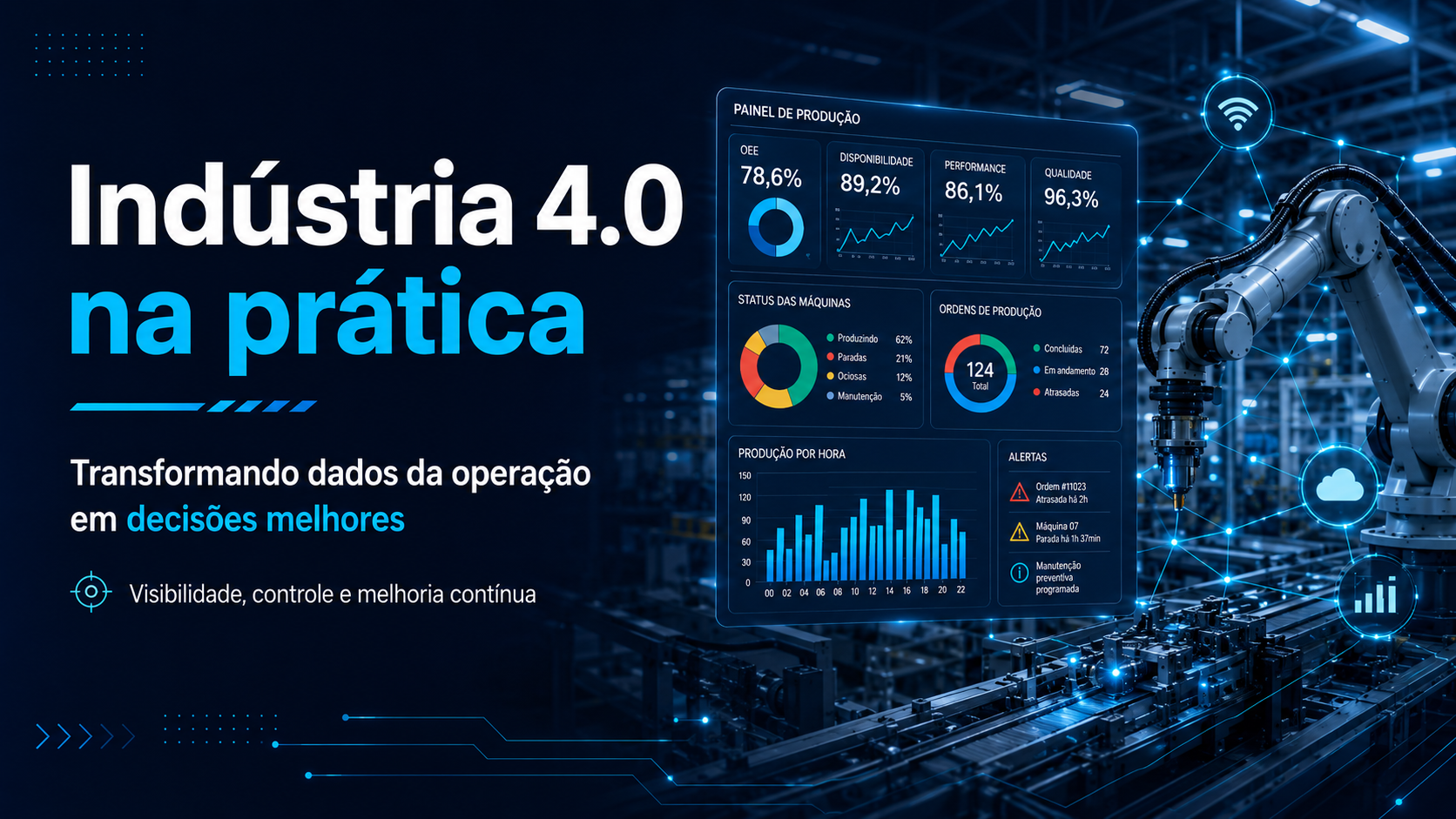
Much is said about Industry 4.0, digital transformation, sensors, automation, artificial intelligence and real-time data. But, in practice, what does all this really mean for an industry?
Industry 4.0 is not just about installing modern machines or buying advanced software. It represents a change in how industrial operations are monitored, analyzed and managed. It is the shift from an industry that reacts to problems to an industry that can see, measure, predict and act more intelligently.
In other words: Industry 4.0 is turning production data into better decisions.
Before Industry 4.0: perception-based decisions
In many companies, most decisions still depend on manual logging, spreadsheets, paper notes or the experience of those on the factory floor.
This does not mean the operation is wrong. Many industries grew this way. The problem is that this model has limits.
When data arrives late, incomplete or relies on manual entry, management sees the factory with delay. The stoppage has already happened. The batch has already been delayed. The machine has already been idle. Quality issues have already caused rework.
In this scenario, the company makes decisions looking at the past.
In practice, Industry 4.0 is visibility
The first major benefit of Industry 4.0 is operational visibility.
This means knowing, with greater precision:
which machines are producing;
which are stopped;
why they stopped;
how long each process took;
which orders are delayed;
where there are bottlenecks;
which sectors need attention;
what the real performance of the operation is.
With reliable data, management stops relying solely on “gut feelings” and begins to monitor the operation with greater clarity.
Industry 4.0 does not start with the robot, it starts with the data
There is a misconception that Industry 4.0 is something distant, expensive and reserved only for highly automated large factories.
In practice, transformation can start simply: collecting important operational data.
An old machine can be part of Industry 4.0 if it is connected to a system that monitors its operation. A manual process can be digitized if the information is recorded in a structured way. A production order can generate indicators if the logging is done correctly.
The central point is not the level of factory automation, but the ability to turn the operation into useful information.
Practical examples of Industry 4.0
In practice, an industry begins to apply Industry 4.0 concepts when it starts using solutions such as:
Machine monitoring
Sensors and systems monitor equipment operation, identifying statuses such as machine on, stopped, in production or in failure. This helps reduce idle time, understand stoppage causes and improve production efficiency.
Digital production logging
Instead of relying on paper or spreadsheets filled later, operators record information directly in digital systems. This improves data reliability and enables near real-time production monitoring.
Management dashboards
Visual indicators help managers see the operation quickly. Production, stops, delays, efficiency, scrap and productivity are now monitored with greater clarity.
Digital checklists
Inspection, trial, quality, maintenance and release processes can be standardized with digital checklists. This reduces errors, improves traceability and avoids loss of important information.
Integration between sectors
Industry 4.0 also enables connecting production, maintenance, quality, engineering and management. When data flows better, sectors stop working in isolation and begin to work more coordinated.
Analysis and continuous improvement
With data history, the industry can identify patterns, bottlenecks and improvement opportunities. The focus shifts from merely solving isolated problems to continuously improving the process.
The main benefit: operational control
Industry 4.0 helps the company answer questions that are often difficult to answer accurately:
How long did my machine actually produce today?
What was the main cause of stoppage this week?
Where am I losing the most time?
Which process is delaying delivery?
Which equipment needs attention?
Which sector is overloaded?
Is my production improving or worsening?
These answers enable more secure action. The company stops operating in the dark and gains real control over its processes.
Industry 4.0 does not replace people
Another important point: Industry 4.0 does not mean removing people from the operation. On the contrary, it helps people make better decisions.
Operators begin to record information more easily. Managers see problems faster. Maintenance teams can act more planned. Quality gains more traceability. Management receives more reliable indicators.
Technology does not replace human knowledge. It expands the team's ability to see and improve operations.
The ideal path is to start with the right problem
An efficient digital transformation does not start by buying technology. It starts by understanding which problems need to be solved.
Does the industry want to reduce downtime?
Improve traceability?
Control production orders better?
Reduce rework?
Increase productivity?
Improve communication between sectors?
Monitor machines and environment?
From these answers, it is possible to choose the correct solutions and implement Industry 4.0 gradually, with clear return to the operation.
Conclusion
In practice, Industry 4.0 means connecting processes, collecting reliable data and turning that information into better decisions.
It is not just about technology. It is about management, efficiency, traceability and continuous improvement.
The industry that adopts this path begins to see its operation better, reduce waste, anticipate problems and make decisions with more confidence.
Transformation does not need to start big. It needs to start at the right point.
Comments